
ISLAMIC ARTS
WHAT IN THE WORLD IS ISLAMIC ART?
When explorers began travelling to far-flung areas of the world they found art that was very similar in places that were often thousands of miles apart. The common thread was the influence of Islam or Muslims in this art and hence the term “Islamic Art” was coined.
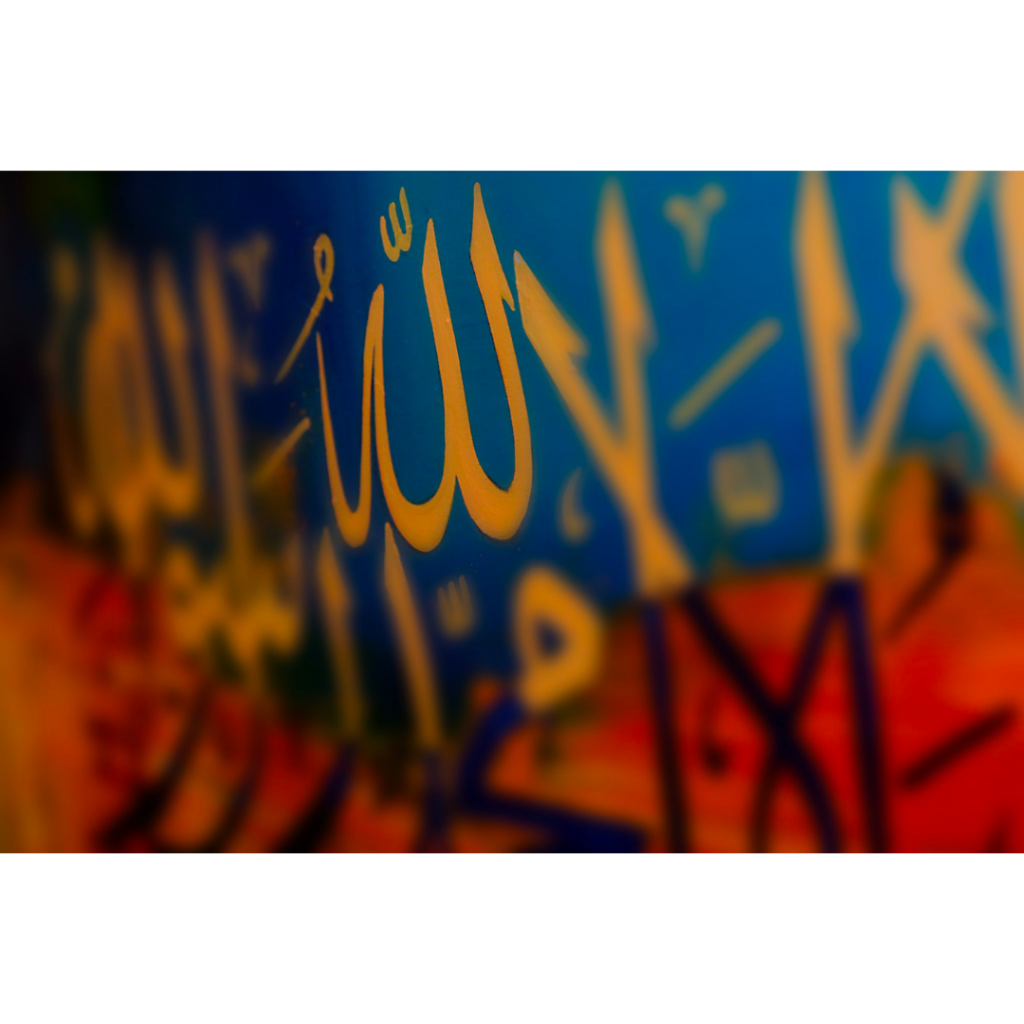
The prevalent underlying theme is Calligraphy or the ‘word of God” written in a beautiful style.
There is often a decorative pattern consisting of undulating and repetitive floral or petal pattern. These patterns are seamlessly repeated as many times as desired creating an infinite pattern that can be repeated over and over again. Anything else that you can think of that is “Infinite” and “Omnipresent”?
Patterns are often very detailed and intricate. Though the artist seeks to recreate Gods perfection he acknowledges that his art is but a reflection of the sublime.
There is often less emphasis on producing something new or innovative. The artist is trying to present God’s beauty rather than express their own feelings or personal ideas.
Can you spot a mandala and undertake a meditative journey back to the center of yourself by following the repeating patterns in the circle, as the lines moves closer and closer to the center?
Do you see any human forms, animals, gargoyles or other creatures? Instead Geometric and floral patterns adorn Islamic Arts providing an element of peace and tranquility.
Islamic art encompasses the visual arts produced from the 7th century onwards by people who lived in the Muslim world. The similarities between art produced at widely different times and places in the Islamic world is the key feature of Islamic art. It encompasses a wide range of media that includes calligraphy, painting, ceramics, woodwork and textiles.
It reflects the culture, beliefs and traditions of Islam.
Typically Islamic art has focused on calligraphy and the use of interlacing patterns, rather than on figures, because it is believed by many Muslims that the depiction of the human form is idolatry and thereby a sin.




CALLIGRAPHY
Calligraphy is the most revered form of Islamic art. It is used to represent God or “the word of God” which is The Quran. Muslim artists seek to create art by glorifying the words from The Quran.
Muslims believe that depicting figurative images of God is akin to idolatry. Therefore Muslim artists channel their artistic expressions towards decorating the word of God through calligraphy. Over the centuries this art has matured as a functional communicative script as well as artistic and graphic decorations on the walls and ceilings of Mosque and other buildings.


ARABESQUE
Arabesque is an artistic pattern created by repeating elements of geometrical floral or vegetal designs. It is a form of artistic decoration that consists of an elaborate, rhythmic repetition of patterns of interlacing foliage, plants or plain lines.

TEXTILES
Textile art encompasses rugs, carpets and silk adornments. Many provide practical usage in daily life such as floor coverings, prayer rugs, coverings for religious objects, cushions and wall coverings that provide architectural enrichment to the room.

CERAMICS
Islamic art has very notable styles in ceramics, both in pottery and tiles. These items include vases, vessels, plates, — both for functional and decorative purposes. Some are richly adorned with Arabesque patterns and others bare inscriptions from the Quran.

GLASS
Glassmaking flourished under Muslim rulers in the various production centers of Egypt, Syria and Persia. Religious objects such as mosque glass lamps were beautifully adorned with floral motifs and inscriptions from the Quran. Miniature glass paintings were a form commonly encountered in Persia.
WOOD
Wood carvings were mostly made for functional and architectural purposes but also provided excellent opportunity for fine decoration. Most of the existing examples of wood carving are relief or pierced work on flat objects for architectural use; such as screens, doors, roofs, beams and friezes. Some of the Arabesque carving on doors and window screens is extremely intricate and mesmerizing. Another example of functional yet decorative wood work are the complex muqarnas that fill in the niches in roof corners giving a stalactite-like appearance to the adorned structure’s architecture. The finest examples of these are found in the Alhambra palace in Spain. These are often in wood and plastered over before painting.

METALWORKING
Medieval Islamic metalwork offers a complete contrast to the European art, which is dominated by modelled figures and brightly colored decoration in enamel. In contrast Islamic metalwork consists of practical objects, with elegant surfaces highly decorated with dense Arabesque pattern. The color is mostly restricted to inlays of gold, silver, copper. Household items, such as ewers or water pitchers, were made of one or more pieces of sheet brass soldered together and subsequently worked and inlaid.
The use of drinking and eating vessels in gold and silver, the ideal in ancient Rome and Persia as well as medieval Christian societies, is prohibited by the Hadiths, as was the wearing of gold rings by men. Most artisans therefore used brass, bronze, tin and steel. Commonly seen are candlesticks and lamp-stands, lantern lights, bowls, dishes, basins, buckets, pen-cases and plaques. Ewers and basins were brought for hand-washing before and after each meal, so are often lavishly treated display pieces. Specialized objects include knives, arms and armor and scientific instruments such as astrolabes, as well as jewelry. Decoration is typically densely packed and very often includes arabesques and calligraphy.